Children's social companion robot
Moxie
- Active · advising · Gen-1 revival + Gen-2 direction
- Advisor · Product direction (Gen-2) · AI agent infrastructure · Interaction experience
- 10,000+ deployed robots being revived
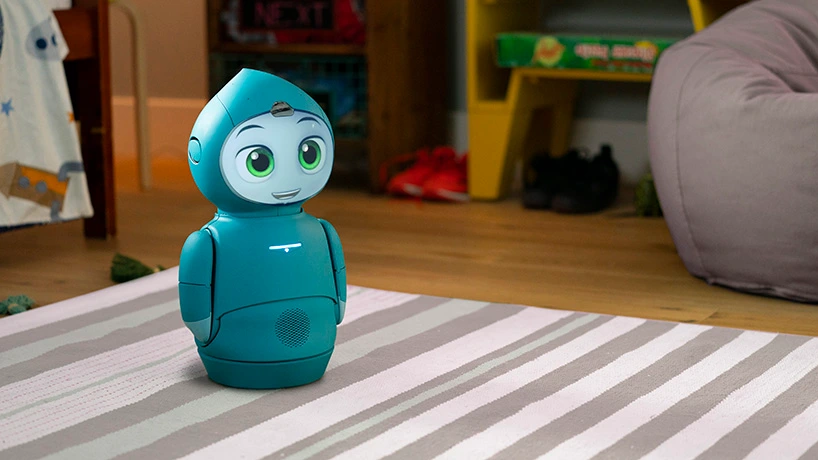
A social-emotional companion robot for children, with a distinctive teal body, expressive animated face, designed by Yves Béhar / fuseproject for Embodied Inc. Reached ~10,000+ homes before Embodied wound down in late 2024; the cloud services that gave Moxie its personality went dark with the company, leaving families with bricked devices and no clear path forward.
Moxie Robots Inc. took on the revival. Advising the team on product direction across two distinct, simultaneous problems: bringing the existing fleet back to life, and designing what Moxie should be next.
Gen-1 revival. Restoring the deployed fleet: agent backbone, conversation, missions, parental experience. The technical problem is harder than it looks: the original architecture predated modern LLM-era agents and was tightly coupled to retired infrastructure. The product problem is harder still. The device has to feel like the same Moxie the kids already knew, not a new robot wearing an old shell.
Gen-2 product direction. Helping define what the next product should be. The original was an extraordinary industrial design moment paired with pre-LLM agent infrastructure. Gen-2 has to integrate modern conversational capability while preserving the personality, pace, and emotional intelligence that made the first robot feel alive rather than like a chatbot in a shell. Where does the device sit in a child’s day; what’s the cadence; what does the family see; what doesn’t it do.
AI agent infrastructure. Working with the team on the agent stack: long-horizon memory, multi-turn personality, mission and story framework, parental controls, on-device vs. cloud split, latency targets for a face-to-face interaction. The constraint that shapes everything: every decision compounds into whether the robot feels like a friend or like a product.
Interaction experience. Pace, listening, expression, repair. A child-facing companion carries design constraints almost no other consumer product carries: patience, predictability, age-appropriate scaffolding, restraint that makes the robot feel like a friend rather than a tutor. Most of the work is not adding capability; it’s holding capability back at the right moments.
Why this matters. 10,000+ families bought into a relationship with this robot. When the cloud went dark, kids lost what they had treated as a friend. The revival isn’t a feature-set conversation. It’s a continuity conversation. Bringing a beloved product back online without losing what made it loved is, in some ways, the inverse of a typical zero-to-one founder problem.